Automating a manual morning check: shipments against port data
An example of a routine lookup: someone checks a shipment list against the port's data every morning and reports what needs attention. We set Lilla up to do it on a schedule. The same setup works for most checks of this kind.


Why we built this
Many teams have a check that someone does by hand every day. There is a list they keep, a website or portal where they look each item up, a rule for what needs attention, and a short report to the people who have to act. The lookup is manual because the source is someone else's system, and on a busy day the check gets skipped.
Lilla can do this kind of check on a schedule. It reads your list, looks each item up in the source, applies your rule and sends the report.
We picked one example to show how this works: an importer's morning shipment check. Someone keeps a list of what is arriving, checks each ship on the port's website, and decides whether to book the truck or warn the customer.
The example
The Maritime and Port Authority of Singapore (MPA) publishes ship schedules and arrivals on OCEANS-X. We used it with a Google Sheet of eight import shipments, each on a real container ship that was due in Singapore. The customers, deadlines and the ETAs the team noted are made up for the demo.
The sheet has one row per shipment:
| Shipment | Customer | Vessel | ETA noted | Delivery deadline | Owner |
|---|---|---|---|---|---|
| DEMO-0431 | Harbourline Furniture | EVER CONSIST | 19 Oct 11:00 | 23 Oct 12:00 | Priya |
| DEMO-0432 | Pasir Panjang Foods | WAN HAI 358 | 19 Oct 21:30 | 20 Oct 14:00 | Marcus |
| DEMO-0433 | Kallang Coffee Roasters | BANGKOK EXPRESS | 19 Oct 19:30 | 24 Oct 17:00 | Marcus |
| DEMO-0434 | Tampines Medical Supplies | EVER BURLY | 20 Oct 06:00 | 22 Oct 12:00 | Priya |
| DEMO-0435 | Jurong Auto Parts | YM TRUTH | 20 Oct 02:00 | 23 Oct 10:00 | Wei Ling |
| DEMO-0436 | Changi Electronics | CMA CGM VALENCIA | 20 Oct 10:00 | 21 Oct 09:00 | Wei Ling |
| DEMO-0437 | Bukit Timah Books | ONE HUMBER | 20 Oct 13:00 | 25 Oct 17:00 | Marcus |
| DEMO-0438 | Serangoon Home & Living | COSCO SAO PAULO | 20 Oct 16:00 | 23 Oct 12:00 | Priya |
The sheet also holds each ship's IMO number, the identifier MPA uses to look it up. All times are Singapore time.
What this looks like in use
Every morning at 6:00 Singapore time, Lilla runs this question:
Which shipments in the import roster need attention today? Check each vessel's arrival against MPA, show the change from the ETA we recorded, and flag a shipment if the delivery deadline is less than 48 hours after arrival, the arrival is more than two hours later than recorded, or there is no arrival record and no current schedule. Name the owner for each one.
For each shipment, Lilla checks whether the ship has already arrived or when it is now expected, compares that with the ETA in the sheet, and works out the hours left before the delivery deadline.
For the screenshot below we started the same scheduled check by hand at 03:38 Singapore time on 20 October.
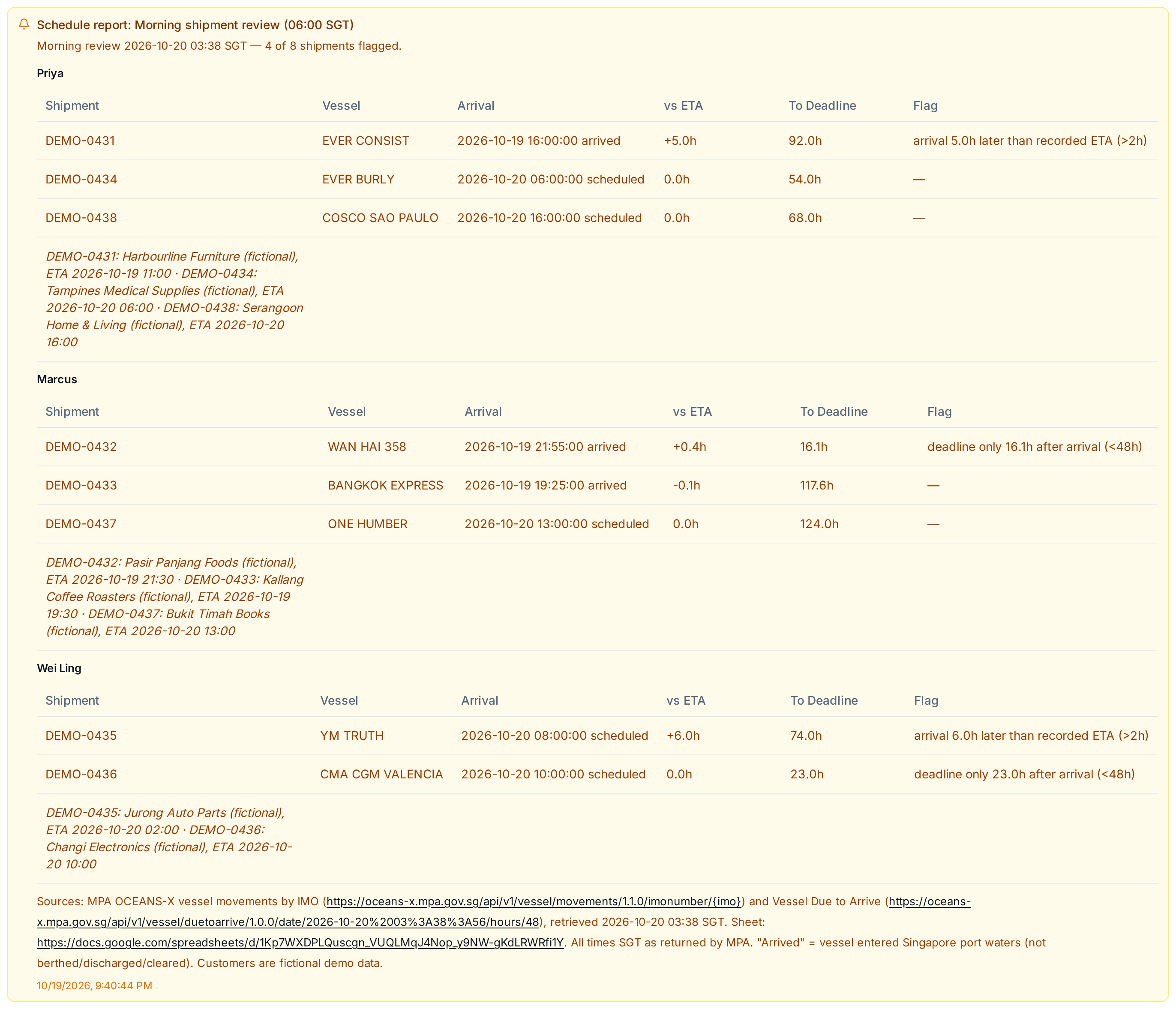
In this example, Lilla flagged four of the eight shipments.
EVER CONSIST arrived at 16:00 on 19 October, five hours after the ETA in the sheet. YM TRUTH is now expected at 08:00 on 20 October instead of 02:00, six hours later. Both went to their owners as late arrivals.
WAN HAI 358 arrived on time at 21:55, but the delivery is due at 14:00 the next day, about 16 hours later. CMA CGM VALENCIA is on schedule for 10:00 with a deadline 23 hours after that. Neither ship is late, but both deliveries are tight enough that the owner should book the truck now.
The other four ships arrived or are expected within a few minutes of the sheet, with at least 54 hours to their deadlines.
The result is the same report the person doing the check would write, ready before the team starts work.
Other checks with the same shape
The shipments are only the example. The same setup fits any check where your list is compared with a source someone looks up by hand today:
- stock levels against a supplier's portal
- open invoices against the payments in your bank account
- booked flights against the airline's schedule changes
- your prices against a competitor's website
Each one needs your list, the source, the rule for what needs attention and the person who gets the report. You write the rule in plain language, as in the question above.
How it works
The dashed boxes are the sources. Lilla only reads from them.
Access and checking
MPA makes this data available through an API with a key. You add the key to the agent once, and Lilla sends it only to MPA. Lilla reads the sheet and MPA's data and changes neither. Each arrival time in the answer names its source and when it was read, so anyone can check a line before acting on it.
For this demo we checked every arrival time and hour figure in the answer against direct calls to MPA.
If your team has a check like this, tell us what it is.
Contains information from MPA OCEANS-X Vessel Due to Arrive and Vessel Movements, accessed 20 October 2026, made available under the MPA API Terms of Service. Customers and shipments in this demo are fictional.